In 2025, the total scale of data centers in China has exceeded 8.7 million standard racks (based on 2.5kW/rack), with large-scale and above data centers accounting for over 60%. During the same period, the explosive growth of global generative AI and large language models is driving up computing power demand at an unprecedented rate. Just as the industry focuses on chip performance leaps and algorithm iterations, water resources—the "invisible cornerstone" supporting digital infrastructure operations—are gradually becoming a key bottleneck constraining the continued expansion of computing power.
A single 15-megawatt medium-sized data center consumes 300,000 tons of water annually—equivalent to the water volume of 500 standard swimming pools. Today, the Water Usage Effectiveness (WUE), measuring "how much water is consumed per kilowatt-hour of electricity," has become a hard metric for data center sustainability: Alibaba Cloud's self-built data centers have reduced this figure to 1.144 liters, hubs in western regions like Ningxia require it to be no more than 1.05 liters, and pioneers in the east using liquid cooling technology can even achieve below 0.5 liters. However, the reality is that in 2023, 40% of data centers nationwide still consumed over 1 liter of water per kilowatt-hour, leaving a significant gap from the 0.5-liter target.
Water usage and treatment, once dismissed as "logistics chores," are no longer as simple as turning valves and adding chemicals. It has evolved into an interdisciplinary field integrating environmental science, precision chemical engineering, fluid dynamics, and artificial intelligence, linking data center operational costs on one end and compliance red lines on the other, while also bearing on corporate social responsibility. Today, I will discuss the transition of data centers from "heavy drinking" to "smart drinking," along with the challenges and solutions behind this water revolution.

I. Evolution of Cooling Technology: From "Extensive Water Consumption" to "Intelligent Water Conservation"
Looking back at the development of data center cooling technology, it is essentially a journey of continuous struggle with power density and ongoing optimization of water resource demand. Over the decades, this field has undergone four key evolutions, each step reflecting humanity's deep consideration of the "balance between computing power and water resources."
1. Extensive Era (1960s-2009): Cooling Towers Like Tireless "Water-Guzzling Beasts"
Early data centers primarily used air-cooled direct expansion systems. Limited by technological levels, cooling efficiency was low (PUE was generally high), and single-rack cooling capacity was limited. As server power density rapidly increased, water-cooled systems, leveraging their superior heat dissipation efficiency and cost advantages, gradually achieved large-scale adoption after 2005, forming a centralized cooling architecture of "cooling towers + chillers"—achieving full-area cooling for the entire data center through water evaporation.
The core design logic of this phase was "ensuring cooling stability," with no systematic constraints on water consumption. Cooling towers acted like unregulated "water tigers," exchanging uncontrolled evaporation for stable machine room temperatures, consuming large amounts of freshwater resources. In essence, this was an era of exchanging extensive water resource consumption for stable computing power output.
2. Awakening Era (2010-2017): Initial Practice of Free Cooling
After 2010, with rising energy costs and the popularization of green development concepts, the industry began to recognize the importance of water resource constraints, and cooling technology entered the "efficiency awakening" phase. Evaporative cooling and various free cooling technologies emerged, becoming landmark breakthroughs of this period.
Taking indirect evaporative cooling technology as an example, by setting up a "heat exchange intermediary," it allows outdoor dry and cold air to first exchange heat with water, then transfer the cooling capacity to the interior of the data center, significantly reducing reliance on high-energy-consuming equipment such as compressors, while also minimizing water evaporation loss. The indirect evaporative cooling units deployed by Huawei in northwest China have achieved water savings of over 50% compared to traditional cooling towers.
However, this stage of technology still relies on water evaporation and is significantly limited by climatic conditions—in high-humidity areas, its cooling efficiency drops markedly. Nonetheless, the exploration during this period marked a shift in industry awareness from "passive water consumption" to "active water conservation."
3. Liquid Cooling Revolution (2017-2021): Disruptive Breakthrough in Cooling Paradigms
The explosive growth of AI and high-performance computing (HPC) has pushed the power density of single cabinets beyond the limits of traditional cooling technologies—from 10kW to over 50kW. Against this backdrop, liquid cooling technology emerged as a "disruptor," fundamentally reshaping the relationship between data centers and water resources.
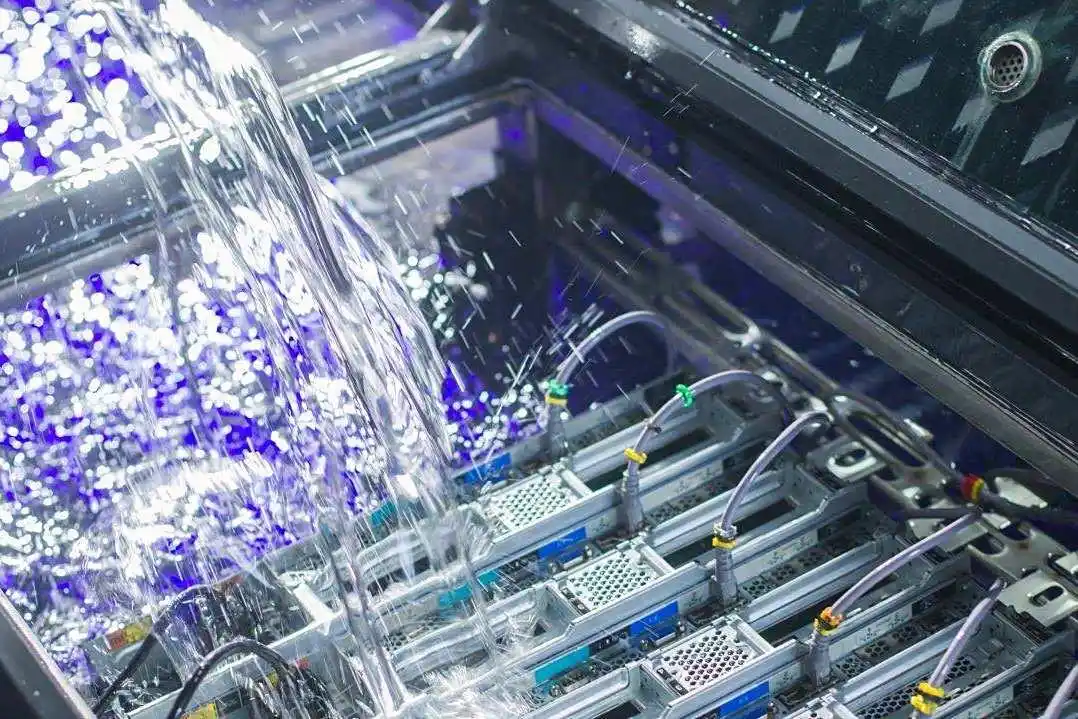
Cold plate liquid cooling efficiently dissipates heat through metal cold plates in direct contact with high-heat sources like CPUs/GPUs, requiring only minimal water replenishment to compensate for system leakage. Immersion liquid cooling goes even further—servers are directly submerged in insulating coolant, with heat removed through liquid circulation, eliminating the need for water evaporation entirely. After Alibaba's Zhangbei data center adopted immersion liquid cooling technology, a single server room saved tens of thousands of tons of water annually, with a water-saving rate exceeding 90%.
The revolutionary significance of liquid cooling technology lies not only in the magnitude of cooling efficiency improvement but also in providing a feasible path toward "water-free cooling," enabling data centers to break free from absolute reliance on water evaporation for heat dissipation.
4. Intelligent Water-Free Era (2022–Present): AI as the "Water Conservation Manager"
Entering 2022, cooling technology has entered a new phase driven by the dual engines of "water-free + intelligent." On one hand, water-free cooling solutions represented by "Xuanbing" technology achieve complete replacement of cooling towers based on phase-change refrigeration principles, with a water usage effectiveness (WUE) of 0—a 100MW data center applying this technology can save over 1.2 million tons of water annually.
On the other hand, for the vast installed base of water-cooled systems, AI-enabled intelligent operations and maintenance have become key to improving water efficiency. Huawei's iCooling@AI system monitors water temperature, flow rate, and water quality parameters in real time, using algorithms to dynamically adjust cooling tower operation modes and chemical dosing, combined with closed-loop technologies such as reverse osmosis (RO) and softening treatment, to maximize water recycling. For example, the system can increase cooling tower utilization during nighttime when wet-bulb temperatures are lower (trading moderate water consumption for reduced electricity use) and switch to mechanical cooling during peak daytime electricity pricing (trading moderate electricity consumption for reduced water use), achieving a dynamic balance between water and electricity consumption.

II. Core Challenges in Current Intelligent Computing Center Water Treatment
Despite continuous technological progress, hyperscale data centers and newly built intelligent computing centers in 2025 still face three major water treatment challenges that urgently need resolution, directly constraining the sustainable expansion of computing power.
Challenge 1: Geographic Mismatch Between Computing Power Expansion and Water Resource Constraints
The explosion of AIGC has pushed CPU/GPU Thermal Design Power (TDP) well beyond 1,000 watts, with single-rack power density commonly exceeding 50kW, leading to an exponential increase in water consumption for traditional evaporative cooling systems. A 50MW intelligent computing center can consume up to 190,000 tons (approximately 50 million gallons) of water annually, and most of this water lost to evaporation cannot be returned to local aquifers, resulting in "single-use consumption."
More critically, there is a mismatch between water resource distribution and computing power layout: approximately 60% of data centers in the United States are located in areas with moderate to high water stress. While data center clusters in western China benefit from lower electricity prices, some regions also face insufficient water resource endowments. This mismatch has made obtaining new water permits extremely difficult, and water resources have become a hard constraint on computing power expansion—for instance, three data center expansion projects in Texas, USA, were shelved in 2024 due to the inability to secure new water withdrawal permits.
Challenge 2: The Specificity of Water Treatment in High-Precision Scenarios
Data center water treatment, serving high-precision IT equipment, exhibits technical characteristics distinctly different from ordinary industrial scenarios:
· Zero-Tolerance Requirement: Requires 7×24 uninterrupted operation; minor water quality fluctuations (e.g., excessive ion concentration, microbial growth) can cause equipment overheating and shutdown, whereas ordinary industrial scenarios can tolerate short-term downtime for maintenance.
· High Recirculation Pressure: To improve water efficiency, systems commonly adopt a high cycle of concentration (≥5), leading to accelerated accumulation of ions and microbial metabolites in the water, imposing extremely high demands on the compatibility and dosing accuracy of water treatment chemicals.
· Dual Risk Overlay: Microorganisms not only form biofilms that reduce heat exchange efficiency, but pathogens such as Legionella can also endanger the health of maintenance personnel. Additionally, data center equipment uses diverse materials (copper, steel, aluminum alloys, etc.), each with varying sensitivity to water quality, further complicating the adaptation of water treatment.
· Environmental Risk: Waste fluorinated liquid from coolants is typically classified as hazardous waste with persistence, bioaccumulation, and toxicity. Meanwhile, 20%~30% aqueous solutions of ethylene glycol (or propylene glycol, etc.) are high-COD organic compounds, both raising environmental concerns. The EU and North America have successively introduced policies to control hazardous waste disposal, require low-GWP fluorinated liquids, set VOC limits and disclosure requirements, and manage hazardous waste under RCRA tracking. International standards such as ASHRAE and ISO also specify coolant performance, environmental management, and leak response requirements. In the future, both international and domestic environmental policies will further tighten, with continuously rising entry barriers. Therefore, it is recommended to prioritize low-risk alternatives, strengthen leak monitoring and recycling to ensure compliance, and these considerations must be integrated from the initial design phase.
It must be noted that the consequences of water treatment failure are extremely severe: studies show that a 0.3mm layer of scale on a condenser can reduce unit energy efficiency ratio by 10%-15%; pipe corrosion can lead to leaks, causing cold plate damage, chip overheating, and even IT equipment short circuits and data loss; microbial outbreaks can lead to public health incidents such as Legionnaires' disease, while illegal discharges can result in hefty fines and reputational damage.
In summary, the future implementation of new national standards will impose stricter requirements on the compliance and conformity of data center water treatment.
Challenge 3: The Dynamic Balance Challenge of Water-Electricity Consumption
What makes it even more challenging is the inherent "water-electricity trade-off" in cooling systems: research shows that for every 1 kWh of electricity saved in a typical evaporative cooling system, an additional 1.8-2.4 liters of water must be consumed; conversely, relying on mechanical refrigeration to save water increases electricity consumption by 8%-12%.
By 2025, this contradiction has become even more acute. Grid capacity is increasingly strained, peak-to-valley electricity price differences can exceed threefold, and coupled with the instability of renewable energy generation, operations teams are "balancing the books" every day: Is today's water intake limit sufficient? Should peak electricity pricing be avoided? Can carbon emission targets be met? This is no longer something that can be handled by experience alone; it requires real-time AI computation, but not every data center has the capability to deploy such a system.
III. Path to Breakthrough: Both Technology and Management Must Be Strengthened
Addressing the water resource constraints of data centers requires a dual-drive approach of technological breakthroughs and management innovation, building a full-chain solution of "source water conservation - recycling - intelligent regulation."
1. Technological Innovation: Reducing Water Dependence at the Source
Large-scale application of liquid cooling technology is the core direction. Immersion liquid cooling systems developed by companies such as Sugon and Envicool achieve zero water consumption operation through dry heat exchangers that exchange heat with air, achieving water savings of over 90%; cold plate liquid cooling targets precise heat dissipation for high-heat components, consuming only one-tenth the water of traditional cooling towers, and is currently accelerating adoption through cost optimization.

Utilization of non-traditional water sources is an important supplement. Amazon's Ohio data center treats rainwater using MBR (Membrane Bioreactor) + RO technology, saving 120,000 tons of water annually with a reuse rate of 30%; a supercomputing center in Beijing uses municipal reclaimed water treated by ultrafiltration + reverse osmosis for cooling make-up, achieving a utilization rate of 80% and replacing 200,000 tons of tap water annually; Tencent's Shenzhen data center recovers air conditioning condensate (after simple filtration) for cooling tower make-up, with a recovery rate of 90% and annual water savings of 30,000 tons. The application of these technologies significantly reduces data centers' dependence on municipal tap water.
2. Management Upgrade: From Passive Operations to Lean Operations
For the vast number of existing water-cooled data centers, innovation in management models is equally crucial. Future water treatment operations and maintenance will evolve towards lean, specialized, and circular practices.
Specialized service outsourcing can significantly improve management efficiency. Nalco's "3DTRASAR" intelligent water management service for GDS data centers uses online sensors to monitor water quality parameters in real time, combined with solid-formula chemicals and an automated dosing system, achieving a 40% reduction in cooling tower blowdown rate and annual water savings of 30,000 cubic meters. This integrated model of "operations training - chemical management - digital monitoring" entrusts specialized tasks to professional teams, effectively avoiding the technical shortcomings of in-house operations.
Cascade Utilization of Water Resources expands the boundaries of water conservation.The perspective of operations and maintenance management needs to go beyond the data center itself and consider the "cascade utilization" of water.A data center in a Beijing industrial park treats the cooling system return water with MBR before using it for municipal toilet flushing and green irrigation within the park, reducing the entire park's tap water procurement by 15%. In the future, condensate recovery and rainwater harvesting systems should become standard configurations for data centers, establishing a cascade utilization chain of "cooling makeup water - secondary use - discharge treatment."
Full Lifecycle Management must run through the entire project.From the design phase, follow the requirements of the "Data Center Design Specification" (GB50174) to set up emergency water storage facilities and backflow prevention devices; during the operation phase, strictly implement water quality monitoring and chemical management specifications to ensure water-saving compliance throughout the system's lifecycle.
AI-Driven Intelligent Operations is key to dynamic optimization.Google's deployed AI cooling control system has achieved a 40% reduction in cooling power consumption; Huawei's iCooling@AI has verified an annualized PUE reduction of 8% to 15% in multiple projects. These systems, through building automation (BA) systems with second-level response, enable coordinated and precise control of equipment, solving the dynamic balance challenge between water and power consumption.
Conclusion:
Water resource management in data centers has evolved from a peripheral logistical task to a core competitive factor.In the future, the advancement of computing infrastructure will no longer rely solely on PUE (Power Usage Effectiveness) but will be jointly defined by PUE, WUE (Water Usage Effectiveness), and CUE (Carbon Usage Effectiveness).
As the saying goes, the future era of computing power will surely be an era where "every drop of water is cherished." Through the deep integration of large-scale liquid cooling technology, widespread adoption of non-traditional water sources, efficient and precise water treatment, and intelligent operations management, data centers will gradually break free from water resource constraints, laying a solid foundation for the sustainable development of the digital economy.