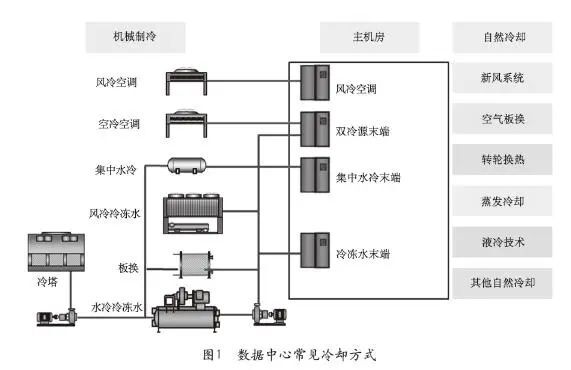
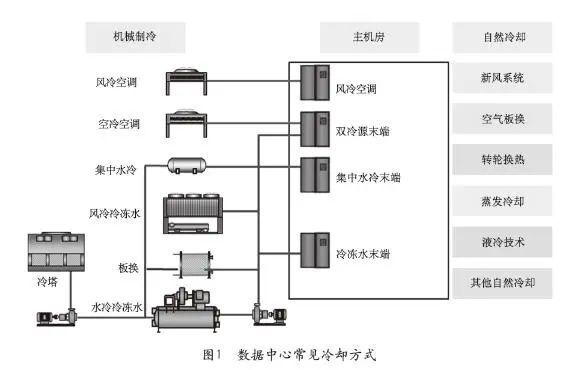
There are multiple cooling methods, which can be divided into mechanical refrigeration and natural cooling based on the cooling approach. Mechanical refrigeration can be further categorized into architectures such as air-cooled direct expansion air conditioning systems, air-cooled chilled water systems, water-cooled chilled water systems, and centralized cooling water systems. Natural cooling includes technologies such as fresh air cooling, air plate heat exchangers, rotary heat exchangers, evaporative cooling, and liquid cooling, as shown in Figure 1.
I Air-Cooled Direct Expansion System
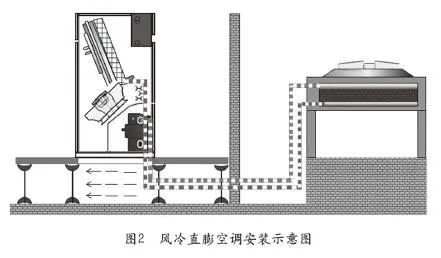
This is the most traditional cooling method. The air conditioner consists of an indoor unit and an outdoor unit connected by refrigerant piping. The indoor unit is composed of a compressor, expansion valve, and evaporator, enabling functions such as refrigeration and air delivery. The outdoor unit is used for heat dissipation. The air-cooled air conditioning architecture is very simple, typically with one indoor unit corresponding to one or two outdoor units, as shown in Figure 2.
1 Principle of Air-Cooled Direct Expansion System
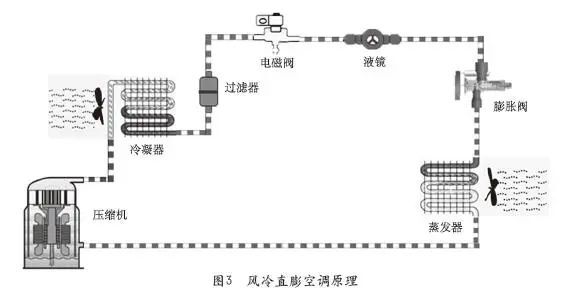
The air conditioner consists of a compressor, condenser, expansion valve, and evaporator. Under the action of the compressor, the refrigerant circulates within the system, undergoing a two-phase transition from liquid to gas and back to liquid, completing a refrigeration cycle, as shown in Figure 3. The refrigerant absorbs heat from the equipment room in the evaporator, boils, and vaporizes into steam. The corresponding pressure is called the evaporation pressure, and the temperature is called the evaporation temperature. The compressor continuously draws the steam generated in the evaporator, compresses it to the condensation pressure, and then sends it to the outdoor condenser. The refrigerant condenses into a liquid under the condensation pressure, transferring the released heat to the outdoor air.
2 System Features
The air-cooled direct expansion system has a simple structure and flexible layout. Since each air conditioner is independent of each other, there is no single point of failure, ensuring high reliability. By adopting the N+X design and layout method, it can meet the cooling requirements of Class A data centers.
When using air-cooled direct expansion air conditioning units, the horizontal and vertical distances between the indoor and outdoor units should be as short as possible to prevent attenuation of cooling capacity. The outdoor unit should be arranged to facilitate heat dissipation. The heat dissipation capacity of the condenser can be appropriately increased based on outdoor installation requirements to improve heat dissipation and reduce energy consumption. In the Zhejiang region, the typical PUE value of BJIDC is around 1.71.
3 Fluorine Pump Energy Saving
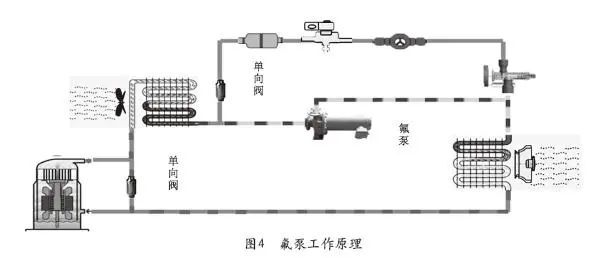
Fluorine pump energy saving mainly consists of a liquid receiver, a fluorine pump, and pipeline valves. When the outdoor ambient temperature is higher than the indoor ambient temperature, the compressor system operates normally, and the fluorine pump system stops working. When the outdoor ambient temperature is below 5°C, significantly lower than the indoor ambient temperature, and reaches the set point of the system control, the compressor stops working, and the fluorine pump starts. The refrigerant, after exchanging heat with indoor air in the evaporator, directly enters the air-cooled condenser to exchange heat with the outdoor cold source. The refrigerant, cooled into a liquid state, returns to the evaporator under the action of the fluorine pump to continue heat exchange, achieving energy-saving effects, as shown in Figure 4. Normal operating modes include compressor mode, fluorine pump mode, and combined cooling mode. In the Zhejiang region, the typical PUE value after adopting fluorine pump technology is around 1.43.
II Centralized Water-Cooled Chilled Water Air Conditioning
1 Water-Cooled Chilled Water System Principle
The water-cooled chilled water system mainly consists of a water-cooled chiller, plate heat exchanger, chilled water circulation system, terminal equipment, cooling water circulation system, and cooling tower fan system, as shown in Figure 5.
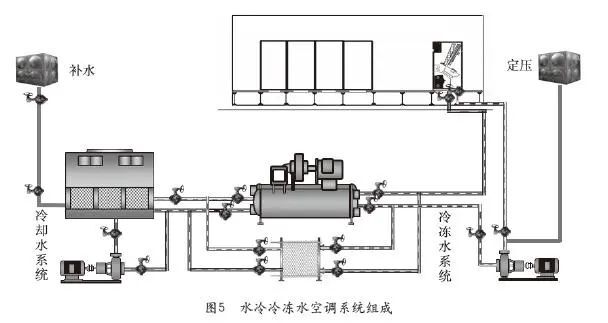
The water-cooled chiller compresses the refrigerant into a liquid state via the compressor and sends it to the evaporator for evaporation. The chilled water circulation system uses a chilled water pump to deliver normal-temperature water into the evaporator coil for heat exchange with the refrigerant. The normal-temperature water is cooled into low-temperature chilled water, which is then sent to the terminal cooling coil to absorb heat from the equipment room, thereby reducing the room temperature.
2 Characteristics of Water-Cooled Chiller Units
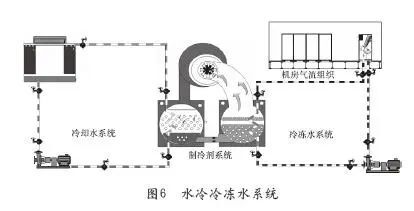
Using water cooling and centrifugal units, it offers high efficiency and large capacity. Water cooling avoids the disadvantage of poor cooling performance common with air cooling in summer, ensuring safer system operation and better energy efficiency, making it suitable for scenarios with high heat loads in data centers, as shown in Figure 6.
3 Free Cooling
The water-cooled chilled water system uses water for cooling and is not constrained by outdoor dry-bulb temperature, so its efficiency remains unaffected during summer operation. In winter, a plate heat exchanger can be used for free cooling, resulting in high annual energy efficiency. Water-cooled chiller units typically employ high-power centrifugal chillers with an energy efficiency ratio of 6.0 or higher, significantly exceeding the compressor efficiency of air-cooled computer room air conditioners. The disadvantage is that the water-cooled chiller system is complex in composition and requires numerous facilities, including a chiller room, cooling tower, cooling water pump, chilled water pump, water collector, and water distributor. The water system is intricate and requires professional maintenance and monitoring. Additionally, the cooling water system consumes a large amount of cooling water resources. During operation, scale buildup occurs in the water system, necessitating water treatment.
4 System Characteristics
Advantages: Uses a cooling tower for heat dissipation, occupying a small footprint with good heat dissipation performance; high centrifugal compressor efficiency; in winter, a plate heat exchanger enables free cooling. Disadvantages: The system is complex in composition with high investment costs, involving both cooling and chilled water systems, making construction, implementation, operation, and maintenance complicated; the water system has low reliability, posing a risk of water ingress into the equipment room; there is a single point of failure, requiring equipment redundancy, loop networks, or dual systems to address reliability issues. Common layout: Chillers have high energy efficiency, and equipping the final load with plate heat exchanger free cooling can achieve good energy efficiency, making it a widely adopted solution in large data center facilities. The typical PUE value for a data center in Zhejiang Province is 1.43.
III Centralized Air-Cooled Chilled Water Air Conditioning System
The chilled water side configuration is relatively complex. For example, pumps can be designed as single-stage or two-stage pumps; the matching method between pumps and chillers also varies, allowing for multi-chiller-to-multi-pump designs or one-chiller-to-one-pump configurations. The terminal piping can adopt single-pipe, dual-pipe, or loop network structures, and cold storage methods can be considered in series or parallel. The following design approach is a typical configuration in current data centers.
1 Principle of Air-Cooled Chilled Water System
Air-cooled chilled water system uses an air-cooled chiller. The air-cooled chiller utilizes a shell-and-tube evaporator to facilitate heat exchange between water and refrigerant. The refrigerant system absorbs the heat load from the water to produce chilled water. The air-cooled chiller employs an air-cooled finned condenser for heat exchange, with heat dissipated to the outdoor atmosphere by cooling fans, as shown in Figure 7. Compared to water-cooled chilled water systems, the air-cooled chilled water system eliminates the cooling water system, features a compact structure, and does not require a dedicated chiller plant room, making operation and maintenance simple and convenient. The disadvantage is that the air-cooled chilled water system has a smaller capacity, and air cooling is prone to high pressure in summer, making it suitable for scenarios where the outdoor ambient temperature is not too high and the heat load in the equipment room is moderate.
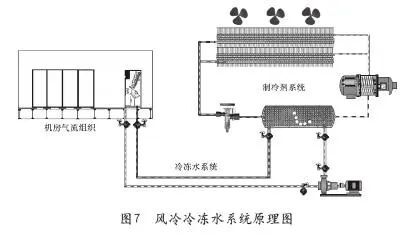
The compressor of the air-cooled chiller is designed with a screw compressor or a magnetic levitation centrifugal compressor. The system structure is compact, and operation and maintenance are simple, but the system capacity is lower than that of a water-cooled chiller. When designing, it is advisable to choose a magnetic levitation compressor for the air-cooled chiller, or a screw compressor as an alternative.
2 Free Cooling
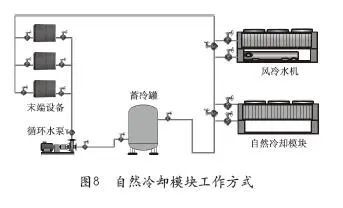
The air-cooled chilled water system can utilize free cooling. When the outdoor temperature is low, cold air can be used to directly cool the chilled water, thereby reducing or eliminating the need for compressor refrigeration operation. This method is called the free cooling method. Units with this function are called free cooling units, or an independent free cooling module can be externally added. The working mode of the free cooling module is shown in Figure 8, enabling refrigeration without compressor operation in winter, thus saving compressor electricity consumption.
3 Features of Air-Cooled Chilled Water System
The auxiliary facilities required for an air-cooled chilled water system are relatively simple, generally including chilled water pumps, water collectors, water distributors, and piping networks. Compared to water-cooled chilled water systems, it is simpler and more cost-effective.
Advantages: Air-cooled units can be directly arranged outdoors without requiring a dedicated chiller room. Additionally, there is no need to install cooling towers and pump rooms. Maintenance is simple, operation is convenient, and no professional personnel are required for upkeep. There is no cooling water system, thus eliminating the power consumption and evaporation loss associated with cooling water systems.
Disadvantages: Air-cooled chilled water units are large in size and occupy significant floor space. Outdoor units also generate high noise levels. The concentrated arrangement of air cooling and outdoor units creates a heat island effect, deteriorating the local ambient environment. The operation of air-cooled chilled water systems is easily constrained by outdoor conditions. During high summer temperatures, efficiency is greatly reduced, and cooling capacity decreases as outdoor temperatures rise, which is contrary to the trend of total heat load demand in data centers.
Furthermore, to address the issue of water freezing in pipelines during winter, ethylene glycol solution can be added to the chilled water system for antifreeze protection. Systems with added ethylene glycol solution can effectively solve the freezing problem in winter. For a data center in Northeast China using an air-cooled chilled water system combined with a natural cooling module, the typical PUE value is 1.48.
4 Water-Cooled Fluorine System (Centralized Cooling Water Air Conditioning System)
1 Principle of Centralized Cooling Water System
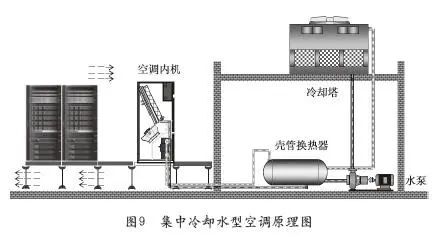
The centralized cooling water system is primarily designed to address the inability to arrange air-cooled condensers and the issue of high summer pressure. The system principle is shown in Figure 9. The computer room air conditioner consists of a compressor, condenser, expansion valve, and evaporator, connected by pipes to form a closed system. The refrigerant circulates within the system, undergoing a two-phase change from liquid to gas and back to liquid, completing a refrigeration cycle. The difference is that the high-pressure, high-temperature gas discharged from the compressor enters the shell-and-tube condenser to exchange heat with cold water for condensation. The cold water from the cooling tower, driven by a water pump, enters the shell-and-tube condenser, becomes hot water, returns to the cooling tower, and is cooled down again.
2 Composition and Architecture of Centralized Cooling Water System
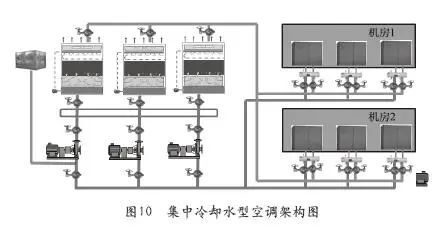
The composition of the centralized cooling water system is relatively simple, mainly consisting of a closed cooling tower, water pump, shell-and-tube condenser, and constant pressure system. The typical architecture is shown in Figure 10. For system safety, redundancy and backup also need to be considered.
3 Characteristics of Centralized Cooling Water System
Advantages: The centralized cooling water system only involves the cooling water system, making it relatively simple with lower construction investment. The use of a closed cooling tower solves the complex cooling water maintenance issues. The use of a shell-and-tube condenser addresses the problem of water entering the computer room.
Disadvantages: The characteristics of the water system determine the existence of single points of failure, which need to be addressed through system redundancy; the efficiency of centralized cooling water systems falls between air-cooled air conditioning and water-cooled chilled water systems. Scenario: Suitable for centralized cooling water systems in large and medium-sized data centers. The typical PUE value in the Zhejiang region is 1.63, while the YQ data center using dynamic dual cold source technology achieves a PUE value of approximately 1.45.
5 Dual Cold Source Air Conditioning
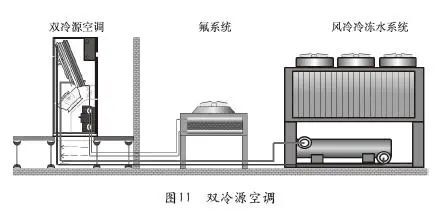
For safety reasons, some data centers sometimes choose dual cold source air conditioning. Dual cold source air conditioning means the air conditioning system has two different types of refrigeration systems. Since the system has two different types of cold sources, there is no single point of failure, and the system operates with high reliability. Dual cold sources can adopt various methods such as chilled water/chilled water, chilled water/refrigerant cooling, etc. Figure 11 shows a refrigerant system and chilled water dual cold source air conditioning unit. Because the unit can use either direct evaporative cooling or chilled water for cooling, the system has high reliability and no single point of failure.
6 Liquid Cooling Technology
With the rapid development of high-density equipment in data centers,server-level cooling has begun to emerge and be used, the most typical of which is liquid cooling technology. Liquid cooling technology involves directly cooling equipment with liquid, where the liquid directly removes the heat generated by the equipment's heating components. Using liquid cooling can achieve natural heat dissipation for equipment such as servers, making it more efficient and energy-saving compared to traditional refrigeration systems.
Commonly used coolants in liquid cooling include water, mineral oil, and fluorinated liquid. Water is an excellent heat transfer medium, low-cost and pollution-free, with good specific heat capacity. However, since water is not an insulator, it can only be used in non-contact liquid cooling technologies. Mineral oil is a relatively low-cost insulating coolant. Single-phase mineral oil is odorless, non-toxic, and not prone to evaporation, making it an environmentally friendly medium. However, mineral oil has high viscosity and tends to leave residues, with a risk of combustion under certain conditions. Fluorinated liquid, due to its insulating and non-flammable inert properties, does not affect equipment and is currently the most ideal and widely used immersion coolant, though it is relatively expensive.
Based on the contact method between the liquid and the heat-generating components, it is roughly divided into cold plate (indirect contact), spray, and full immersion (direct contact).
1 Cold Plate Type
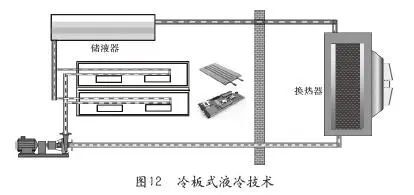
This involves fixing a liquid-cooled cold plate onto the main heat-generating components of the server, using the liquid flowing through the cold plate to carry away heat for cooling purposes. Cold plate liquid cooling addresses the heat dissipation of high-heat components in the server, while other low-heat components still rely on air cooling. Therefore, servers using cold plate liquid cooling are also called air-liquid dual-channel servers. The liquid in the cold plate does not contact the cooled components, with heat transfer through a thermal conductive plate, ensuring high safety, as shown in Figure 12. A drawback is that after adopting cold plate liquid cooling, the data center still requires room-level air conditioning to maintain ambient temperature.
2 Spray Liquid Cooling
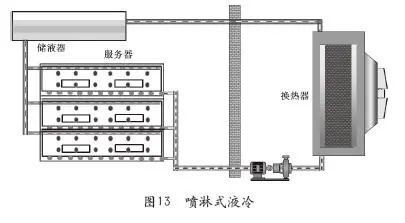
This involves storing liquid and opening holes at the top of the chassis, where coolant is sprayed onto the heat-generating components based on their location and heat output, achieving equipment cooling, as shown in Figure 13. The sprayed liquid directly contacts the cooled components, resulting in high cooling efficiency. A drawback is that when the liquid encounters high-temperature objects during spraying, there may be slight drift and evaporation, with droplets and gases escaping through gaps and holes in the chassis, reducing the cleanliness of the data center environment or affecting other equipment.
3 Immersion Liquid Cooling
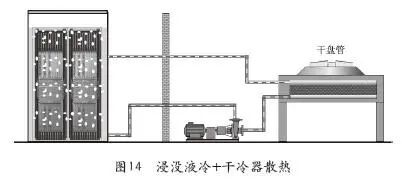
Heat-generating components are directly immersed in the coolant, relying on the liquid flow circulation to remove the heat generated by equipment such as servers during operation. Since the heat-generating components are in direct contact with the coolant, immersion liquid cooling offers higher heat dissipation efficiency, lower noise compared to cold plate liquid cooling, and can handle higher heat density. It is a typical direct-contact liquid cooling method. Immersion liquid cooling is divided into two-phase and single-phase types, with single-phase being more commonly used. Heat dissipation methods can include dry coolers and cooling towers. In two-phase liquid cooling, the coolant undergoes a phase change during the circulation heat dissipation process. Two-phase liquid cooling has higher heat transfer efficiency, but its control is relatively complex, as pressure changes during the phase change impose high requirements on the container, and the coolant is prone to contamination during use, resulting in fewer practical applications.
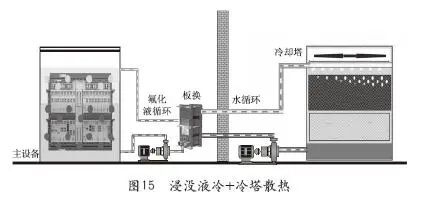
In single-phase liquid cooling, the coolant remains in a liquid state throughout the circulation heat dissipation process without undergoing a phase change. Therefore, single-phase liquid cooling requires a coolant with a high boiling point, making the control of coolant evaporation and loss relatively simple and ensuring good compatibility with IT equipment components. Depending on the application scenario specifications, fluorinated liquid can be used with a dry cooler (Figure 14) or with a cooling tower and plate heat exchanger for heat dissipation (Figure 15).
7 Common Energy-Saving Technologies
Data centers require cooling year-round. In winter and transitional seasons, when outdoor temperatures are lower than indoor temperatures, abundant natural cold sources exist. Rationally developing and utilizing natural cold sources is a key measure to reduce data center energy consumption and lower the PUE of the equipment room. When selecting a site and determining technical solutions for a data center, natural cold sources should be developed and utilized based on local conditions. Depending on the carrier of natural cold sources, technical solutions for natural cold sources can be broadly categorized into cold air free cooling, evaporative cooling, and chilled water free cooling. Based on the heat transfer path, they are further divided into direct free cooling and indirect free cooling.
1 Fresh Air System
This directly utilizes the cooling capacity of outdoor cold air. Outdoor cold air is filtered by a fan and directly introduced into the equipment room, avoiding the need to start the compressor and saving energy, as shown in Figure 16. This cooling method has the highest efficiency and is suitable for use in areas with good air quality.
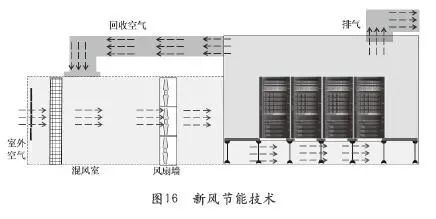
When applying a direct fresh air system, it is necessary to thoroughly evaluate the annual air quality of the region. Since outdoor air contains harmful components such as dust, sulfur dioxide, hydrogen sulfide, and ozone, direct fresh air intake poses risks of contaminating the equipment room and corroding cabinets. In practice, certain air treatment measures, such as physical filtration, chemical filtration, and humidity control, must be considered to meet the environmental requirements of the equipment room.
2 Plate Heat Exchanger System
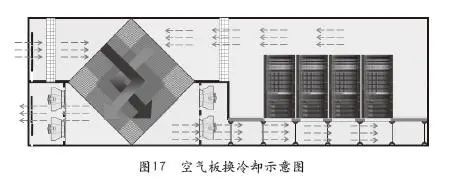
By using a plate heat exchanger to isolate outdoor air for heat exchange, the cooled air is sent into the equipment room, as shown in Figure 17. Since outdoor air cannot directly enter the equipment room, the air plate heat exchanger is suitable for use in environments with air pollution. Its cooling efficiency is lower than that of a fresh air system, making it suitable for environments with air pollution where a fresh air system is not suitable. When the outdoor temperature is high, mechanical cooling is required.
3 Rotary Wheel System
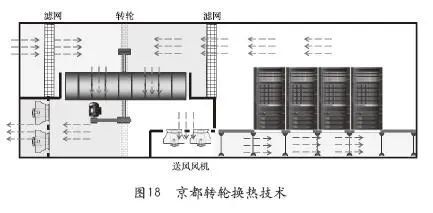
This is a total heat exchange technology, initially used in Tokyo, Japan, hence also called the Kyoto rotary wheel. The principle is shown in Figure 18. It can exchange not only heat but also humidity. Its function is similar to that of a plate heat exchanger. Through the rotation of the wheel, outdoor air and indoor air undergo heat and moisture exchange at the wheel. This method has relatively high cooling efficiency and is suitable for environments with air pollution where a fresh air system is not suitable. Due to slight cross-contamination during use, the rotary wheel total heat exchange has no significant advantage compared to the plate heat exchanger.
4 Evaporative Cooling System
In dry climate regions, evaporative cooling technology can be used to further extend the operation time of natural cooling, thereby maximizing the reduction of energy consumption in the data center air conditioning system. Depending on whether water and air are in direct contact, evaporative cooling technology is divided into two types: direct evaporative cooling and indirect evaporative cooling.
Direct Evaporative Energy-Saving Technology
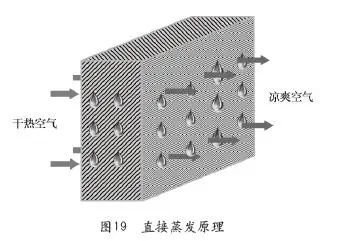
Direct evaporative cooling involves direct contact between air and water. As water evaporates, the air temperature decreases. Its characteristic is an isenthalpic humidification and cooling process for the air, with the ultimate temperature limit for supply air cooling being the wet-bulb temperature of the incoming air, as shown in Figure 19.
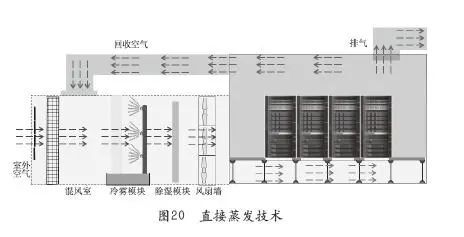
The cooled air after humidification can be used to cool the equipment room. In practical applications, it can be combined with a fresh air system. When the outdoor temperature is low, fresh air is used directly for cooling. When the outdoor temperature rises, the humidification system is activated; after water evaporates and the air temperature drops, it enters the equipment room for cooling. This extends the duration and efficiency of natural cooling and is suitable for use in areas with good air quality, as shown in Figure 20. It should be noted that the evaporation process affects the humidity in the equipment room.
Indirect Evaporative Energy-Saving Technology
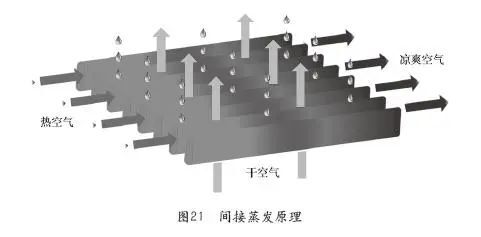
Indirect evaporative cooling refers to transferring the cooling capacity of the moist air obtained from direct evaporative cooling to the circulating air in the equipment room through a non-contact heat exchanger, achieving an isohumid cooling process for the air, as shown in Figure 21. In this process, after treatment, both the dry-bulb and wet-bulb temperatures of the secondary air decrease, while the moisture content remains unchanged. This results in an enthalpy-reducing, isohumid cooling process for the supply airflow, with the ultimate temperature limit for supply air cooling being the dew-point temperature of the incoming air.
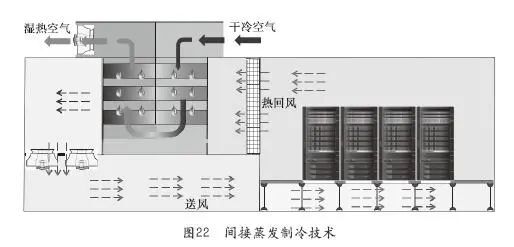
By isolating outdoor air through an evaporative heat exchanger, outdoor air cannot directly enter the equipment room, making it suitable for use in polluted air environments. Although the cooling efficiency is lower than that of direct evaporative technology, outdoor pollutants cannot enter the equipment room. Additionally, the evaporation process does not affect the humidity of the equipment room. The cooling principle is shown in Figure 22. The core component of indirect evaporation is the evaporation module, and its airflow organization consists of two parts: indoor airflow and outdoor airflow.
Conclusion
Data centers should select appropriate cooling methods and natural cooling approaches based on factors such as construction scale, geographical location, and meteorological conditions, in order to fully reduce cooling costs and enhance economic benefits.